2026年真题01
Listening Module • 47 Questions
Listening Modules
Module1-Router
Q1-Q32 · 20 materials · 32 questions · Choose Response, Conversation, Announcement, Academic Talk
Choose Response
Q1-Q12 · 12 materials · paper total 15 materials
Q1
multiple_choice
Module1-Router
Choose Response
Woman: Where can I find the class notes?
🎧 Question Audio
Answer: B | Correct Rate: 92.87%
Q2
multiple_choice
Module1-Router
Choose Response
Woman: Who's handling this year's school fundraiser?
🎧 Question Audio
Answer: B | Correct Rate: 70.46%
Q3
multiple_choice
Module1-Router
Choose Response
Man: I don't know how many people will join us tonight for study group.
🎧 Question Audio
Answer: D | Correct Rate: 94.21%
Q4
multiple_choice
Module1-Router
Choose Response
Man: Peter said he would look for supplies.
🎧 Question Audio
Answer: C | Correct Rate: 89.51%
Q5
multiple_choice
Module1-Router
Choose Response
Woman: Why is the air conditioner in the dorm not working?
🎧 Question Audio
Answer: B | Correct Rate: 83.58%
Q6
multiple_choice
Module1-Router
Choose Response
Woman: Who is the guest lecturer today?
🎧 Question Audio
Answer: D | Correct Rate: 95.43%
Q7
multiple_choice
Module1-Router
Choose Response
Woman: Who is the tutor in the student success center today?
🎧 Question Audio
Answer: C | Correct Rate: 84.42%
Q8
multiple_choice
Module1-Router
Choose Response
Woman: Maybe the power went out for this whole area.
🎧 Question Audio
Answer: D | Correct Rate: 66.49%
Q9
multiple_choice
Module1-Router
Choose Response
Woman: Did you go to the university sponsored picnic on Sunday?
🎧 Question Audio
Answer: A | Correct Rate: 95.97%
Q10
multiple_choice
Module1-Router
Choose Response
Woman: Did you enjoy the gardening class?
🎧 Question Audio
Answer: A | Correct Rate: 97.47%
Q11
multiple_choice
Module1-Router
Choose Response
Man: Can you turn down the volume?
🎧 Question Audio
Answer: C | Correct Rate: 91.78%
Q12
multiple_choice
Module1-Router
Choose Response
Man: Who is in charge of the event?
🎧 Question Audio
Answer: A | Correct Rate: 97.17%
Conversation
Q13-Q18 · 3 materials · 6 questions · paper total 5 materials
Q13
multiple_choice
Module1-Router
Conversation
🎧 Passage Audio
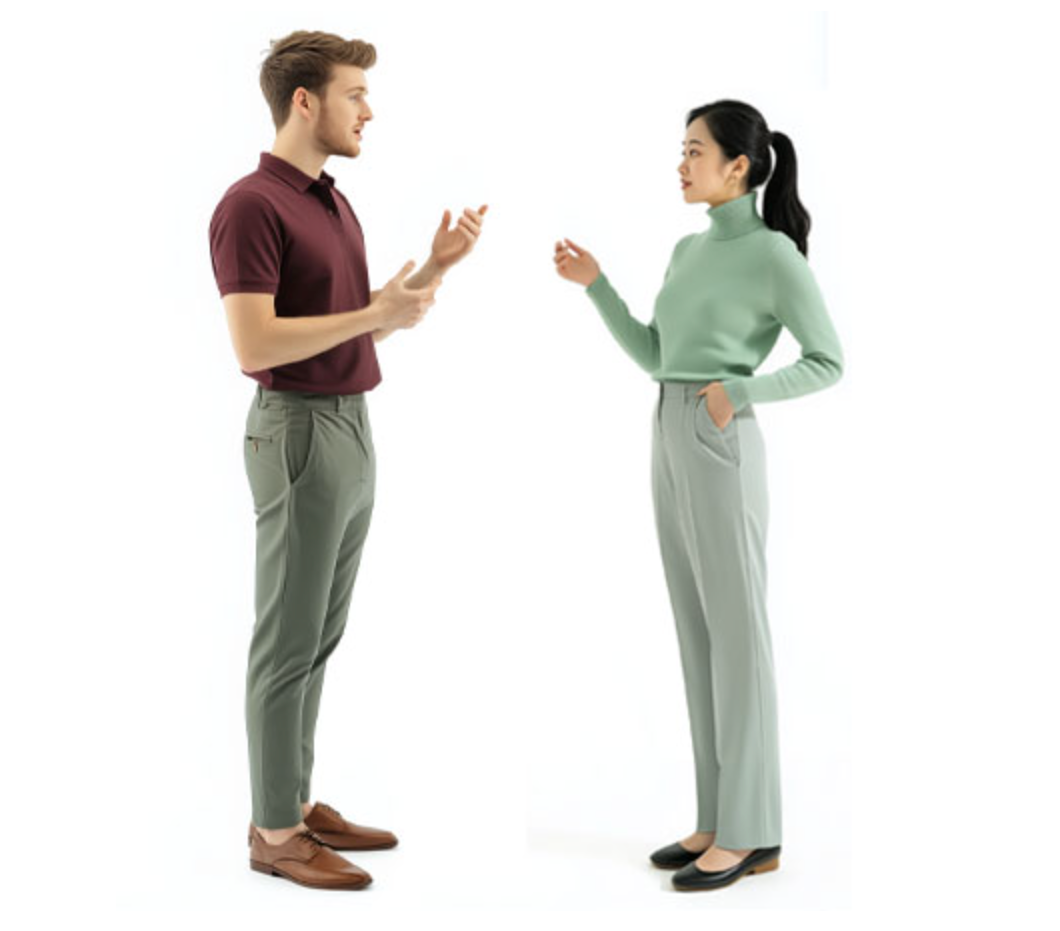
Woman: Listen to a conversation. Man: Hi. I need to return this sweater. I bought it yesterday, but it's too small for me. Woman: Sure. Do you have the receipt? Man: Yes, I have it right here. Woman: Great. We can process the return. Do you want to exchange it for a larger size or get a refund? Man: I'd like to exchange it, please. Woman: No problem. I will get another in that color for you from our stock. Man: Thank you.
Why is the man returning the sweater?
Answer: B | Correct Rate: 89.41%
Q14
multiple_choice
Module1-Router
Conversation
What will the woman most likely do next?
Answer: C | Correct Rate: 91.41%
Q15
multiple_choice
Module1-Router
Conversation
🎧 Passage Audio
Man: Listen to a conversation. Do you have time to do me a favor? Woman: I'm about to run to the post office, but I can help you after that. Man: I'm hosting this dinner party tonight and I need to pick up some last minute groceries. Woman: What do you still need? Man: I need vegetables and ingredients for a dessert. Here's a list. Woman: No problem. I can swing by the market after I've mailed my package. Man: You're a lifesaver. Thanks a million.
What is the man doing later today?
Answer: B | Correct Rate: 90.61%
Q16
multiple_choice
Module1-Router
Conversation
What is the woman likely to do next?
Answer: C | Correct Rate: 61.72%
Q17
multiple_choice
Module1-Router
Conversation
🎧 Passage Audio
Man: Listen to a conversation Man: Have you heard about the concert that the university orchestra is putting on in the park? I know you're a big fan of classical music. Woman: I am. And I'm already going with a group of friends. You should come with us. Man: Thanks, I'd love to. So how much are tickets? Woman: You only have to pay if you sit in the seats up close near the stage. We're all going to bring blankets and just sit on the grass a little farther back. Man: Good idea. I'll bring a blanket too.
What are the man and the woman talking about?
Answer: C | Correct Rate: 84.0%
Q18
multiple_choice
Module1-Router
Conversation
What does the man imply when he says, "I'll bring a blanket too"?
Answer: D | Correct Rate: 86.28%
Announcement
Q19-Q24 · 3 materials · 6 questions
Q19
multiple_choice
Module1-Router
Announcement
🎧 Passage Audio
Listen to an announcement at a school art exhibit. Man: Thank you for touring this special collection of paintings we recently acquired from a donor. We're going to begin with late 18th century works in the hallway on your left. We'll then proceed to early 19th century in the next room and finish with the modern art collection on the next floor. But first, I'll pass out a detailed map of the collection, which includes some artist information on the back.
What is the purpose of the announcement?
Answer: C | Correct Rate: 71.02%
Q20
multiple_choice
Module1-Router
Announcement
What will the speaker probably do next?
Answer: D | Correct Rate: 72.23%
Q21
multiple_choice
Module1-Router
Announcement
🎧 Passage Audio
Listen to an announcement in a university classroom. Man: I'm pleased to announce that we'll have a guest speaker next week as part of our unit on environmental policy. Dr. Maya Tan will join us on Thursday and she'll be speaking about international climate agreements, the role of youth activism, and current challenges in global sustainability efforts. There will be time for questions at the end, so feel free to prepare some in advance. This talk should give you valuable insights for your upcoming group project, so please make sure to be there.
What field does the guest speaker most likely work in?
Answer: A | Correct Rate: 76.37%
Q22
multiple_choice
Module1-Router
Announcement
What does the speaker imply about the guest lecturer's talk?
Answer: A | Correct Rate: 89.31%
Q23
multiple_choice
Module1-Router
Announcement
🎧 Passage Audio
Listen to an announcement in a classroom. Woman: As you know, this is the final course required for your business degree. The course will operate as an independent study. You will each select an area of focus that interests you. Some examples are available on my website. Then, every week, you'll be required to submit short essays that respond to questions I give you on this topic. You'll need to refer to what you've learned in your other business courses so you can cite theories or strategies that support your responses.
What is available on the speaker's website?
Answer: A | Correct Rate: 41.24%
Q24
multiple_choice
Module1-Router
Announcement
Where should the listeners look for theories and strategies?
Answer: B | Correct Rate: 51.26%
Academic Talk
Q25-Q32 · 2 materials · 8 questions · paper total 4 materials
Q25
multiple_choice
Module1-Router
Academic Talk
Physics
Process/problem -> cause/effect/solution
🎧 Passage Audio
Listen to a talk in a physics class. Man: We've been talking about the law of inertia. An object moving in a straight line will continue to move in a straight line unless it is acted upon by another force. So what does this mean in the real world? Let's look at something many people do all the time, riding a bicycle. Think about riding along in a straight line. Once the bike is moving, inertia will keep it going in a straight line. But we don't just ride in straight lines, do we? We turn at corners and steer around things that are in our way. So how do you get the bicycle not to go straight? Easy, right? Don't you just need to turn the front wheel in the direction you want to turn? In fact, if you only turn the front wheel, you're likely to end up on the pavement. The wheel will turn, but because of inertia, your body and the rest of the bike will want to keep moving straight ahead. So how does a cyclist avoid this? The key is to lean in. Weight needs to shift in the direction of the turn so that the force of gravity can work against the force of inertia. Professional cyclists who move at high speeds need to hit a sweet spot. They must lean more to keep their bicycles from sliding out of turns, but not too much. At a certain point, gravity will bring both rider and bicycle down to the ground.
What is the purpose of the talk?
Answer: C | Correct Rate: 64.77%
Q26
multiple_choice
Module1-Router
Academic Talk
Physics
Process/problem -> cause/effect/solution
What does the speaker suggest about turning?
Answer: A | Correct Rate: 73.51%
Q27
multiple_choice
Module1-Router
Academic Talk
Physics
Process/problem -> cause/effect/solution
What does leaning in help a cyclist to do?
Answer: B | Correct Rate: 65.81%
Q28
multiple_choice
Module1-Router
Academic Talk
Physics
Process/problem -> cause/effect/solution
What do professional cyclists try to do when turning?
Answer: C | Correct Rate: 69.35%
Q29
multiple_choice
Module1-Router
Academic Talk
Economics
Concept/definition -> evidence/examples -> implication
🎧 Passage Audio
Listen to a talk on a business podcast When launching a new business, entrepreneurs face countless decisions, from choosing a target market to deciding which features to include in their first product. These choices can be overwhelming, especially when resources are limited and time is short. To address these challenges, some startups adopt a strategy that emphasizes speed, experimentation, and customer feedback. This approach, known as the Lean Startup methodology, was popularized by Eric Ries and has gained traction in the tech world and beyond. One of its core practices is building a minimum viable product, or mvp. This is a basic version of a new product that can be released quickly to gather feedback from early users. The goal is to learn what works and what doesn't, so that future development is guided by actual user experience rather than assumptions. Another key principle is validated learning. Instead of doing traditional market research like surveys or focus groups, entrepreneurs test their ideas by putting the product out in the real world. This helps them figure out whether their product actually meets the needs of their customers. In all fairness, I should point out that this approach isn't perfect. Rapid iteration and constant feedback can sometimes lead to confusion or a lack of clear direction. And in the pursuit of efficiency, some teams may cut corners, which could affect product quality. Still, many entrepreneurs find the Lean Startup methodology helpful for navigating the uncertainties of launching a new business.
What is the main topic of the talk?
Answer: B | Correct Rate: 43.34%
Q30
multiple_choice
Module1-Router
Academic Talk
Economics
Concept/definition -> evidence/examples -> implication
According to the talk, what is a minimum viable product, or MVP?
Answer: C | Correct Rate: 53.93%
Q31
multiple_choice
Module1-Router
Academic Talk
Economics
Concept/definition -> evidence/examples -> implication
What does the speaker imply about validated learning?
Answer: A | Correct Rate: 72.45%
Q32
multiple_choice
Module1-Router
Academic Talk
Economics
Concept/definition -> evidence/examples -> implication
Why does the speaker mention the drawbacks of the lean start-up approach?
Answer: C | Correct Rate: 38.74%
Module2-Upper
Q1-Q15 · 7 materials · 15 questions · Choose Response, Conversation, Academic Talk
Choose Response (continued)
Q33-Q35 · 3 materials · paper total 15 materials
Q1
multiple_choice
Module2-Upper
Choose Response
Woman: Who forgot to turn off the lights?
🎧 Question Audio
Answer: D | Correct Rate: 66.36%
Q2
multiple_choice
Module2-Upper
Choose Response
Man: Would you like to eat at the west dining hall tonight?
🎧 Question Audio
Answer: D | Correct Rate: 81.08%
Q3
multiple_choice
Module2-Upper
Choose Response
Man: Did you enjoy the dean's talk yesterday?
🎧 Question Audio
Answer: A | Correct Rate: 95.0%
Conversation (continued)
Q36-Q39 · 2 materials · 4 questions · paper total 5 materials
Q4
multiple_choice
Module2-Upper
Conversation
🎧 Passage Audio
Listen to a conversation. Man:I was just typing my paper and my computer suddenly shut down. Woman: You've had a lot of problems with that laptop, haven't you? Man: Yeah. Woman: Have you tried holding down the power button for a few seconds? Man: I did, but nothing happened. I'd rather not take it to a repair shop, but I don't know what else to do. Woman: How about you get in touch with my ex roommate, Monica? She’s a real tech whiz. Man: Oh, that's an idea. Could you give me her number? I'm not sure I have it anymore.
What is the man's problem?
Answer: D | Correct Rate: 90.31%
Q5
multiple_choice
Module2-Upper
Conversation
At the end of the conversation, what is the man's attitude toward the woman's idea?
Answer: C | Correct Rate: 92.29%
Q6
multiple_choice
Module2-Upper
Conversation
🎧 Passage Audio
Listen to a conversation. Man: This is Jimmy Clerken from Rise Bakery calling. I received a message that you'd like to do a story about my shop for your university newspaper. Woman: Yes. You've been a staple in our city for generations now. The grandparents of our current students were customers there when they were young. Man: It's a family owned business and we're proud of it. Would you be able to come next Monday at 3 o’clock? Woman: Definitely. Is it all right if my photographer comes along? Man: Of course. You can get different shots, even back in our kitchen where we do all the baking.
What can be inferred about the bakery?
Answer: B | Correct Rate: 75.49%
Q7
multiple_choice
Module2-Upper
Conversation
Based on the conversation, what will happen during the interview?
Answer: A | Correct Rate: 65.18%
Academic Talk (continued)
Q40-Q47 · 2 materials · 8 questions · paper total 4 materials
Q8
multiple_choice
Module2-Upper
Academic Talk
Biology
Concept/definition -> evidence/examples -> implication
🎧 Passage Audio
Listen to a talk on a science podcast. Woman: Let's talk a bit about bird migration. Migratory birds travel vast distances between their breeding and wintering grounds, often covering thousands of miles. These journeys are driven by the need to find suitable habitats with adequate food supplies and favorable climate conditions. One of the most remarkable aspects of migration is a bird's ability to navigate accurately over such long distances. Birds use a variety of navigational cues, such as the position of the sun, stars, and, incredibly, Earth's magnetic field. Certain bird species have a special protein in their eyes that allows them to see magnetic fields, and this helps them stay on course. Migratory birds play key roles in ecosystems by dispersing seeds and controlling pests, so their decline can cause imbalances throughout food webs. Of course, a migration over hundreds or even thousands of miles will be fraught with risk. Obvious dangers include harsh weather conditions, predators, and the risk of exhaustion and starvation. Less obviously, human activities also pose significant threats to migratory birds. Habitat destruction, pollution and climate change have led to a decline in many migratory bird populations. At night, light pollution can disorient birds that navigate by the stars, causing them to become lost or collide with buildings. Protecting key habitats and reducing light pollution are a few of the steps that can help safeguard migrating birds. Solutions include bird friendly building design and programs that encourage turning off unnecessary lights during peak migration seasons.
What is the main topic of the talk?
Answer: D | Correct Rate: 77.67%
Q9
multiple_choice
Module2-Upper
Academic Talk
Biology
Concept/definition -> evidence/examples -> implication
How does a special protein in the eyes of some birds help them navigate?
Answer: C | Correct Rate: 67.45%
Q10
multiple_choice
Module2-Upper
Academic Talk
Biology
Concept/definition -> evidence/examples -> implication
What does the speaker warn may cause imbalances in food webs?
Answer: A | Correct Rate: 52.14%
Q11
multiple_choice
Module2-Upper
Academic Talk
Biology
Concept/definition -> evidence/examples -> implication
According to the speaker,what is a measure people can take to protect migrating birds?
Answer: B | Correct Rate: 76.28%
Q12
multiple_choice
Module2-Upper
Academic Talk
History
Concept/definition -> evidence/examples -> implication
🎧 Passage Audio
Listen to a talk in an archaeology class. Often when we think of mummies, we think of ancient Egyptians and their elaborate methods of preserving bodies. We used to think Egyptians were the only people practicing mummification during the Bronze Age about, oh, 4,000 years ago, because typical mummies are found in places, for example, with very dry climates like Egypt. But then archaeologists discovered a site in Scotland with evidence of mummification, and Scotland is, well, wet, rainy. This site is called Cladh Hallan, the only place in Britain where we found prehistoric Bronze Age mummies. So researchers unearthed skeletons at Cladh Hallan, including a man and a woman from around 1500 BCE. Since these were just skeletons, the researchers didn't realize at first that they had actually been mummies. That realization came after doing a test called radiocarbon dating on the bones. Radiocarbon dating revealed that the man and woman had died several hundred years before being buried. Normally, such a long wait would turn a body into a pile of bones, not an actual skeleton, like what was found. So their bodies must have been purposely preserved for hundreds of years before burial. Why? Well, who knows? But we do know how. The bodies were preserved, mummified in a peat bog. Peat bogs are kinda like swamps, except their conditions prevent organic materials like bodies from fully breaking down. They stay more intact. Prehistoric people in Scotland used to preserve animal fat like butter in peat bogs. So they definitely had the concept.
What does the speaker mainly discuss?
Answer: B | Correct Rate: 72.44%
Q13
multiple_choice
Module2-Upper
Academic Talk
History
Concept/definition -> evidence/examples -> implication
What does the speaker imply about Scotland?
Answer: A | Correct Rate: 69.11%
Q14
multiple_choice
Module2-Upper
Academic Talk
History
Concept/definition -> evidence/examples -> implication
According to the speaker,what did radiocarbon dating reveal?
Answer: D | Correct Rate: 51.64%
Q15
multiple_choice
Module2-Upper
Academic Talk
History
Concept/definition -> evidence/examples -> implication
Why does the speaker mention butter?
Answer: B | Correct Rate: 40.77%